

3x 2 2x 16 0
In unproblematic algebra, completing the foursquare is a technique for converting a quadratic polynomial of the class

to the grade
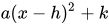
for some values of h and k.
Completing the square is used in
- solving quadratic equations,
- deriving the quadratic formula,
- graphing quadratic functions,
- evaluating integrals in calculus, such as Gaussian integrals with a linear term in the exponent,
- finding Laplace transforms.
In mathematics, completing the square is often applied in any computation involving quadratic polynomials.
History [edit]
Completing the square was known in the Old Babylonian Empire.[1]
Muhammad ibn Musa Al-Khwarizmi, a famed polymath who wrote the early algebraic treatise Al-Jabr, used the technique of completing the foursquare to solve quadratic equations.[two]
Overview [edit]
Groundwork [edit]
The formula in elementary algebra for calculating the square of a binomial is:

For example:
^{2}\,&=\,x^{2}-10x+25\qquad &&(p=-5).\end{alignedat}}](https://wikimedia.org/api/rest_v1/media/math/render/svg/e22c4c34904778f055746900c6f939fc3d29aff2)
In whatever perfect square, the coefficient of x is twice the number p, and the constant term is equal to p two.
Basic case [edit]
Consider the post-obit quadratic polynomial:

This quadratic is not a perfect square, since 28 is not the square of 5:

However, information technology is possible to write the original quadratic as the sum of this square and a constant:

This is called completing the square.
Full general clarification [edit]
Given any monic quadratic

it is possible to class a square that has the same get-go ii terms:

This square differs from the original quadratic but in the value of the constant term. Therefore, nosotros tin can write

where . This operation is known as completing the square. For example:

![{\begin{alignedat}{1}x^{2}+6x+11\,&=\,(x+3)^{2}+2\\[3pt]x^{2}+14x+30\,&=\,(x+7)^{2}-19\\[3pt]x^{2}-2x+7\,&=\,(x-1)^{2}+6.\end{alignedat}}](https://wikimedia.org/api/rest_v1/media/math/render/svg/e905c1705aff97d23a6f09c27d5bb99a1693007e)
Non-monic case [edit]
Given a quadratic polynomial of the form
it is possible to cistron out the coefficient a, and and so complete the square for the resulting monic polynomial.
Case:
![{\displaystyle {\begin{aligned}3x^{2}+12x+27&=3[x^{2}+4x+9]\\&{}=3\left[(x+2)^{2}+5\right]\\&{}=3(x+2)^{2}+3(5)\\&{}=3(x+2)^{2}+15\end{aligned}}}](https://wikimedia.org/api/rest_v1/media/math/render/svg/070251df372b84b3dd6f8c308da9c572ba482c4e)
This process of factoring out the coefficient a can further be simplified by only factorising information technology out of the get-go 2 terms. The integer at the end of the polynomial does not have to exist included.
Example:
![{\displaystyle {\begin{aligned}3x^{2}+12x+27&=3[x^{2}+4x]+27\\&{}=3\left[(x+2)^{2}-4\right]+27\\&{}=3(x+2)^{2}+3(-4)+27\\&{}=3(x+2)^{2}-12+27\\&{}=3(x+2)^{2}+15\end{aligned}}}](https://wikimedia.org/api/rest_v1/media/math/render/svg/29257b47a44421eeb162ed4b1ffa38eae8486a7a)
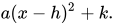
This allows the writing of whatsoever quadratic polynomial in the form
Formula [edit]
Scalar case [edit]
The issue of completing the foursquare may be written as a formula. In the general case, i has[3]

with

In particular, when a = 1, one has

with

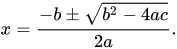
By solving the equation in terms of and reorganizing the resulting expression, one gets the quadratic formula for the roots of the quadratic equation:


Matrix case [edit]
The matrix case looks very similar:

where has to be symmetric.

If is not symmetric the formulae for and accept to be generalized to:


- .

Relation to the graph [edit]

Graphs of quadratic functions shifted to the correct by h = 0, 5, 10, and 15.

Graphs of quadratic functions shifted upwards by k = 0, five, 10, and 15.

Graphs of quadratic functions shifted upward and to the correct by 0, 5, 10, and 15.
In analytic geometry, the graph of any quadratic function is a parabola in the xy-aeroplane. Given a quadratic polynomial of the course
the numbers h and 1000 may be interpreted as the Cartesian coordinates of the vertex (or stationary point) of the parabola. That is, h is the 10-coordinate of the axis of symmetry (i.e. the axis of symmetry has equation ten = h), and chiliad is the minimum value (or maximum value, if a < 0) of the quadratic function.
I way to see this is to annotation that the graph of the function ƒ(ten) =x two is a parabola whose vertex is at the origin (0, 0). Therefore, the graph of the function ƒ(x −h) = (x −h)2 is a parabola shifted to the correct by h whose vertex is at (h, 0), equally shown in the peak effigy. In contrast, the graph of the function ƒ(10) +m =10 two +k is a parabola shifted upward by k whose vertex is at (0,k), as shown in the center figure. Combining both horizontal and vertical shifts yields ƒ(x −h) +k = (x −h)2 +one thousand is a parabola shifted to the right by h and upward by k whose vertex is at (h,grand), as shown in the bottom figure.
Solving quadratic equations [edit]
Completing the square may be used to solve whatsoever quadratic equation. For example:

The first footstep is to complete the foursquare:

Next we solve for the squared term:
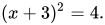
Then either

and therefore

This can be practical to any quadratic equation. When the 10 2 has a coefficient other than 1, the first stride is to divide out the equation by this coefficient: for an example see the non-monic case below.
Irrational and circuitous roots [edit]
Unlike methods involving factoring the equation, which is reliable but if the roots are rational, completing the square will find the roots of a quadratic equation even when those roots are irrational or complex. For example, consider the equation

Completing the foursquare gives

so
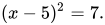
Then either

In terser language:

so

Equations with complex roots can exist handled in the same style. For example:
^{2}+1\,=\,0\\[6pt](x+2)^{2}\,=\,-1\\[6pt]x+2\,=\,\pm i\\[6pt]x\,=\,-2\pm i.\end{array}}](https://wikimedia.org/api/rest_v1/media/math/render/svg/9d58b55ab950dc35a66612eabf42d288ae3c2d0a)
Non-monic case [edit]
For an equation involving a non-monic quadratic, the showtime step to solving them is to dissever through by the coefficient of 10 2. For example:
![{\begin{array}{c}2x^{2}+7x+6\,=\,0\\[6pt]x^{2}+{\tfrac {7}{2}}x+3\,=\,0\\[6pt]\left(x+{\tfrac {7}{4}}\right)^{2}-{\tfrac {1}{16}}\,=\,0\\[6pt]\left(x+{\tfrac {7}{4}}\right)^{2}\,=\,{\tfrac {1}{16}}\\[6pt]x+{\tfrac {7}{4}}={\tfrac {1}{4}}\quad {\text{or}}\quad x+{\tfrac {7}{4}}=-{\tfrac {1}{4}}\\[6pt]x=-{\tfrac {3}{2}}\quad {\text{or}}\quad x=-2.\end{array}}](https://wikimedia.org/api/rest_v1/media/math/render/svg/c2ee0335f9fc70a9d6f1e911da0051ad9970811c)
Applying this procedure to the general form of a quadratic equation leads to the quadratic formula.
Other applications [edit]
Integration [edit]
Completing the square may be used to evaluate any integral of the form
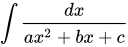
using the basic integrals

For example, consider the integral
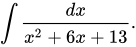
Completing the foursquare in the denominator gives:

This tin can now be evaluated by using the substitution u =x + 3, which yields

Complex numbers [edit]
Consider the expression

where z and b are complex numbers, z * and b * are the circuitous conjugates of z and b, respectively, and c is a real number. Using the identity |u|two = uu * we can rewrite this as

which is clearly a existent quantity. This is because

As another instance, the expression
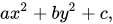
where a, b, c, 10, and y are real numbers, with a > 0 and b > 0, may be expressed in terms of the square of the absolute value of a complex number. Define

Then
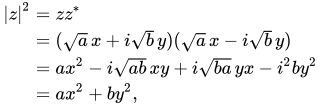
so

Idempotent matrix [edit]
A matrix M is idempotent when M two = Thou. Idempotent matrices generalize the idempotent properties of 0 and 1. The completion of the square method of addressing the equation

shows that some idempotent ii×2 matrices are parametrized by a circumvolve in the (a,b)-aeroplane:
The matrix will exist idempotent provided which, upon completing the square, becomes
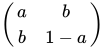

In the (a,b)-plane, this is the equation of a circumvolve with eye (1/2, 0) and radius ane/2.
Geometric perspective [edit]

Consider completing the square for the equation

Since 10 2 represents the area of a square with side of length ten, and bx represents the area of a rectangle with sides b and ten, the procedure of completing the foursquare tin can be viewed as visual manipulation of rectangles.
Unproblematic attempts to combine the x 2 and the bx rectangles into a larger square consequence in a missing corner. The term (b/two)2 added to each side of the in a higher place equation is precisely the surface area of the missing corner, whence derives the terminology "completing the square".
A variation on the technique [edit]
As conventionally taught, completing the foursquare consists of adding the third term, 5 2 to

to get a square. At that place are also cases in which one tin can add the middle term, either 2uv or −2uv, to

to go a square.
Example: the sum of a positive number and its reciprocal [edit]
By writing
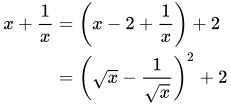
nosotros show that the sum of a positive number x and its reciprocal is always greater than or equal to 2. The square of a existent expression is always greater than or equal to zero, which gives the stated bound; and here nosotros achieve 2 just when x is 1, causing the square to vanish.
Instance: factoring a simple quartic polynomial [edit]
Consider the problem of factoring the polynomial

This is

then the middle term is 2(x 2)(18) = 36x 2. Thus we become
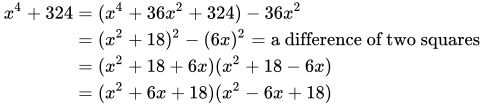
(the terminal line existence added just to follow the convention of decreasing degrees of terms).
The same statement shows that is always factorizable every bit


(Also known as Sophie Germain'south identity).
References [edit]
- ^ Tony Philips, "Completing the Square", American Mathematical Lodge Feature Column, 2020.
- ^ Hughes, Barnabas. "Completing the Square - Quadratics Using Addition". Math Association of America . Retrieved 2022-10-21 .
{{cite spider web}}: CS1 maint: url-status (link) - ^ Narasimhan, Revathi (2008). Precalculus: Building Concepts and Connections. Cengage Learning. pp. 133–134. ISBN978-0-618-41301-0. , Department Formula for the Vertex of a Quadratic Function, page 133–134, figure 2.4.8
- Algebra one, Glencoe, ISBN 0-07-825083-8, pages 539–544
- Algebra 2, Saxon, ISBN 0-939798-62-X, pages 214–214, 241–242, 256–257, 398–401
External links [edit]
- Completing the square at PlanetMath.

3x 2 2x 16 0,
Source: https://en.wikipedia.org/wiki/Completing_the_square
Posted by: paulsonclowboulat.blogspot.com
0 Response to "3x 2 2x 16 0"
Post a Comment