

How Do I Download A Rise Course Examples
Articulate Ascent 360 is a simple app that lets yous create fully responsive courses for any devices from your browser. It's a real game changer for e-learning merely it falls brusk if you want to translate your courses for wider markets.
In this article, I'll guide you through the steps of translating your Rise 360 courses without installing boosted software. Information technology'southward a simple workaround that also supports the needs of larger scale translation efforts if needed.
Past the cease, you lot'll have a productive Rise 360 translation workflow that sets you up for commercial success.
Overview
- How to Interpret Articulate Rise 360 Courses
- Best Practices for Translating Rising 360 Courses
- Summary
How to Translate Articulate Rise 360 Courses (4 Steps)

The Rise 360 app does not have a built-in translate role. However, yous can consign your courses as an XLIFF certificate, which is incredibly useful in building a workflow that involves external translation software.
XLIFF is the industry standard file format for exchanging translation data between unlike tools. In this case, the tools we will utilize are Articulate Ascension 360 and Redokun. You lot can substitute the latter with whatever translation software that supports XLIFF.
Now here's how to translate your Rise 360 content:
Step 1: Duplicate your grade
First, duplicate your course and change the name to include the target language (add abbreviations at the end similar ENG for English or CHN for Chinese). This way y'all'll accept an easier time keeping rail of all your translated courses later. To exercise this:
- Go to your Rise 360 Dashboard
- Hover over the class y'all desire to translate
- Click on the ellipsis that appears
- Cull Duplicate
- Rename the duplicated course
- Click Save

Proceed in listen that simply managers and business relationship owners are able to duplicate courses on Rise 360.
Stride ii: Export your form as an XLIFF Document
At present y'all tin can export your duplicated course as an XLIFF document. To do so:
- Click into said grade and select Settings on the toolbar at the top
- Go to the Translations tab
- Take note of the selections yous can brand under Stride 2. If you lot want to preserve the formatting of your class text, make sure that you select Include HTML Formatting. Otherwise, you may uncheck the box.
- Click Export XLIFF File and relieve it to your estimator

Footstep iii: Translate the XLIFF document on Redokun
Translating your XLIFF file is easier with a translation tool similar Redokun. It's an online translation management organization you tin can access from your browser.
- Log in to your Redokun account or sign up for a free 14 24-hour interval trial here (we won't ask for your credit menu details)
- Upload the XLIFF document you've exported from Rise 360
- The upload wizard volition guide you lot through the steps of setting upwardly your translation projection on Redokun, such as selecting your target linguistic communication(s); inviting and assigning translators for each target language selected - this could be your colleagues or translation vendors
- Your team can start translating using the Redokun Spider web Editor, which also provides calculator-assisted translation tools to speed up their work

Once your team has finished translating the text, you tin download an XLIFF document containing the translations. To do so:
- Become to your Document Detail page
- The Download selection volition be available for a target linguistic communication in one case your translator has confirmed the translation
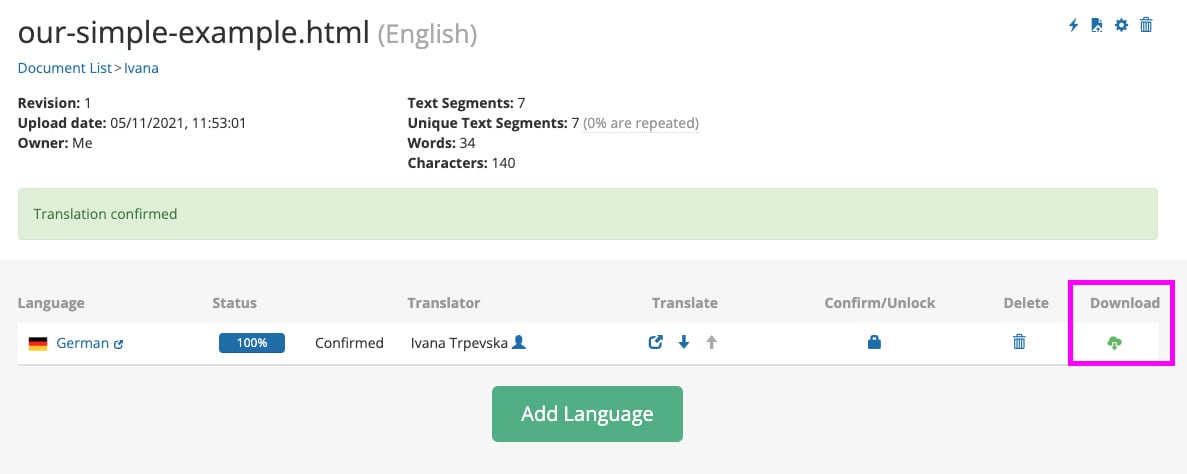
For a full demonstration on how translation projects work on Redokun (complete with screenshots), cheque out this article.
Stride four: Import the translated XLIFF file dorsum to Rising 360
With the translation you've but downloaded from Redokun, the but affair left to do now is to import it back to Rise 360.
- Click into the duplicated form for the target language you want to import
- Select Settings on the toolbar at the top
- Go to the Translations tab
- Whorl down to Step 3 and select Import Translated Text
- Select the translated XLIFF file y'all downloaded from Redokun

And that's all! You're set up to publish your course for a new language market... unless you desire to go the extra mile.
Optional Footstep: Translate class labels

Labels here refer to the textual UI elements throughout your course that either
- prompt user action (eastward.g. Beginning Course, Resume Grade); or
- display learning data (e.g. Must pass quiz before standing)
Permit's say you've translated your form content from English language to Castilian. It would exist useful to translate the labels to Spanish besides to build a more immersive learner experience in ane language.
However, since labels aren't encoded into the exported XLIFF file, you must change them manually in Rise 360:
- Go to the Settings folio of your Rise 360 course
- Click on the Labels tab
- There are ii ways to translate your labels: (1) by choosing from the iii linguistic communication presets: German, French, or Spanish, or (2) by creating a new label set for any other language

Click here for the official guide on how to customize text labels.
And at present your courses are admittedly set for market place.
Why use Redokun?

- Starting time stiff with a translation direction system: Your Rise 360 translation workflow would exist a uncomplicated iv-stride procedure with Redokun. It's fast. It'due south scalable. It's 1 of the core systems that will fix your market expansion plans in move.
- Ensure every translated course brings value to your subsequent projects: Your courses will probable have overlapping content, whether information technology'south one word or one paragraph. If you have translated it before, you tin can translate information technology again with your eyes airtight... because Redokun automatically detects similarities and notice the matching translation. This is a nifty tool known equally translation memories.
- Collaborate with internal and external teams: Always take the option to piece of work with in-firm translators or vendors and share crucial feedback directly in the Web Editor.
- Invest your time in translating your texts, not fixing them: Your translated courses maintain their original stylings and layout when you download them from Redokun. Skip the dreaded "post-production" phase and get straight to market.
- Don't get stuck on hard translations: Your Redokun Web Editor is integrated with automobile translation engines to assist translators kickstart their idea procedure.
Best Practices for Translating Rise 360 Courses

You lot can optimize your Rise 360 translation at many levels. Keep these best practices in mind to translate content effectively for your linguistically diverse audiences.
1. Plan for text expansion
A paragraph written in 1 language might take up more than space than the same paragraph written in another linguistic communication.
Thus, when designing your course, yous should e'er plan for text expansion. In case a translation does use up more characters than the original text, you won't have to readjust the layout.
The general rule is to leave 30% more room to allow the text to expand if needed. Avoid having cramped sections of text in your Rise 360 form.
2. Treatment text in images
Before you even start creating your east-learning courses, yous have to think near the images you desire to use. While they're swell learning aids, translating them is a separate task considering the text in images can't be exported in the XLIFF certificate.
Avoid using images with text in your courses. However, if it'south unavoidable, you will need to consider a tertiary party prototype translation tool. This is a type of software that will detect and extract the text within images - after which you may translate and reattach to the relevant courses.
three. Recall to translate multimedia elements and external attachments
Apart from images, your rise 360 courses may contain other multimedia elements and external attachments, such as videos, audios, eastward-books, downloadable worksheets.
It goes without saying that translating these elements would absolutely improve your user's e-learning journey. However, bear in listen that this will likely increase your localization costs.
Yous can really first some of these costs if your translation software can be used to interpret other types of attachments in your courses.
For example, Redokun supports more than just XLIFF translation. You can also employ it to interpret Word, Excel, PPTX, and video subtitles. Then if you do determine to interpret your supplementary learning materials, you won't need to pay for additional tools, only the people who will exercise the translations.
4. Avoid idioms, jargons, and slangs
These don't always translate well because not all your target languages will share the aforementioned linguistic quirks or cultural values.
Your translation projects volition get by much faster if your translator isn't trying to figure out how to make every idiom or slang word fit into new linguistic and cultural contexts.
Unless you have a defended localization expert on your squad, simplify the linguistic communication of your source text. If there is a way to say what you desire to say in plain linguistic communication, do and then.
v. Use translation software to ameliorate your workflow
And we're not just saying this for shameless self-promotion (okay, maybe a little fleck).
You probably want to translate your Articulate courses into multiple languages, not just ane. That'south going to eat upwards your resource if your squad doesn't approach the work systematically.
You tin utilise tools like Redokun to manage and streamline the translation of your Rise 360 courses. In doing so, your team is always focused on translating the text. Not on copy-pasting lines of text from one place to some other. Not on fixing the layout of the translated courses.
Summary
At the end of the 24-hour interval, y'all have important letters to share through your courses. These messages have more impact if you deliver them in multiple languages.
Although Articulate Rise 360 lacks an integrated translation feature, the primal is to piece of work with the XLIFF file export function. And this applies to any software that allows yous to export your content as an XLIFF certificate.
With this file format, you tin can rapidly upload your content onto whatever translation management organisation like Redokun to savour a more than intuitive workflow.
Do try Redokun for free with your squad today. Experience complimentary to permit u.s.a. know what you think!
Happy translating,
Ivana

How Do I Download A Rise Course Examples,
Source: https://redokun.com/blog/rise-360-translation
Posted by: paulsonclowboulat.blogspot.com
0 Response to "How Do I Download A Rise Course Examples"
Post a Comment